Two-Week Meal Plan on a Budget for Four
Two weeks of dinners work better when you plan the fresh food for the first few days and give the second week to frozen or shelf-stable ingredients. Pick a handful of meals that share rice and beans, with vegetables added where they fit, then buy the perishables only once you know where they’ll go. Freeze cooked portions you won’t eat soon.
Start with the food that won’t wait
Open the fridge before writing a shopping list. If you have half a cabbage plus three carrots and an open tub of yogurt, put them on days one through three. Don’t buy a new bag of salad just because a meal-planning template has a salad on Tuesday.
Check your freezer too. A pound of ground turkey already in there can be a chili night; a bag of peas can cover fried rice later in the plan. The fridge-first meal ideas are useful if the odd bits don’t look like a dinner yet. For a fuller weekly routine, start with how to meal plan on a budget.
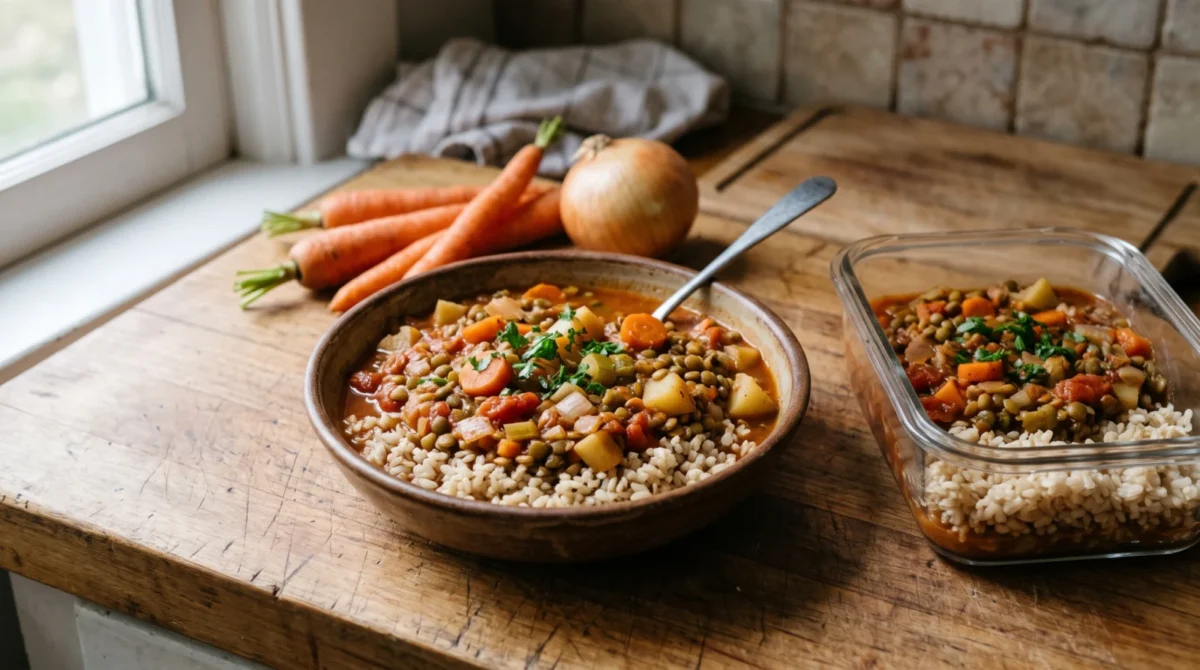
I don’t like planning 14 different recipes. It’s too many half-used jars. Keep it simple. Instead, choose four anchor meals you can cook once and use twice: lentil tomato stew, bean chili, a tray of roasted vegetables and a pot of rice. For the other nights, change the format, not the whole cart. Chili in a bowl becomes a baked-potato topping.
A two-week dinner plan for four
This is a template, not a promise about your checkout total. Assume you have salt and oil, plus a few spices; check before shopping. Meat is optional here: you can add it to the chili if it’s already in your freezer, but the plan doesn’t need it.
| Day | Dinner | Use or prep note |
|---|---|---|
| 1 | Cabbage and bean skillet over rice | Use the oldest cabbage first; cook a large pot of rice. |
| 2 | Lentil tomato stew with carrots | Make extra stew; freeze the second batch promptly. |
| 3 | Egg and pea fried rice | Use properly chilled day-1 rice; cook eggs until set. |
| 4 | Bean chili with baked potatoes | Cook a double batch and freeze half. |
| 5 | Roasted vegetable wraps with yogurt sauce | Use the remaining fresh vegetables and opened yogurt. |
| 6 | Pasta with tomato sauce and white beans | Freeze half the sauce for day 12. |
| 7 | Leftover chili over freshly cooked rice | Use refrigerated chili within the safe window, or thaw a frozen portion. |
| 8 | Thawed lentil stew with toast | Move a frozen portion to the fridge to thaw. |
| 9 | Potato and onion frittata with frozen peas | Buy a small fresh topping only if the budget allows. |
| 10 | Black bean quesadillas | Use tortillas from the freezer and any leftover cheese. |
| 11 | Rice bowls with frozen vegetables and egg | Cook fresh rice rather than keeping week-1 rice. |
| 12 | Pasta with reserved tomato sauce | Thaw the sauce in the fridge; add beans if portions look small. |
| 13 | Baked potatoes with thawed chili | Reheat until steaming hot. |
| 14 | Pantry soup with beans and frozen vegetables | Add the last potatoes or a handful of pasta. |
The day-7 chili is where the plan needs a little care: if you cooked it on day 4, that lands near the end of the FoodSafety.gov cold-storage guidance for cooked leftovers, which is three to four days in a refrigerator at 40°F or below. If your schedule might slip, freeze that serving on day 4 instead. Don’t keep cooked rice around for a week; chill it promptly and make a fresh batch for the second week.
Shop once for the base, then check the fresh food
For four people, a starting list is 2 pounds of dry rice, 1 pound of dry lentils, 1 pound of pasta, 8 cans of beans, 4 cans of tomatoes, 5 pounds of potatoes, 2 pounds of carrots, 2 onions, 1 cabbage, 2 bags of frozen vegetables, a dozen eggs and a pack of tortillas. Add yogurt and cheese only if you’ll use them in the first week. That list covers the dinners above in broad strokes; portions and appetites vary, so adjust before you go to the store.
| Buy for the first shop | Check before week two |
|---|---|
| Rice, lentils, pasta, canned beans and tomatoes | Is there enough pasta or rice for the remaining meals? |
| Potatoes, onions, carrots and cabbage | Are any potatoes soft or damaged? Use sound ones first. |
| Frozen peas or mixed vegetables, eggs | Is there enough freezer space for the extra stew and chili? |
| Tortillas, optional cheese and yogurt | Do you need a small fresh topping, or is it just a habit buy? |
The point of the second check isn’t another full grocery run. It’s a way to catch the one missing ingredient before you order takeout because the pasta is gone. If you want a tighter starting cart, compare it with the budget grocery list for a week, then cross off what your kitchen already holds.
Put a ceiling on dinner spending
Say your own two-week dinner allowance is $112 for four people in the US. That’s a planning example, not a current store price or a claim that this cart costs $112: $112 ÷ 14 dinners = $8 per dinner, or an estimated $2 per serving if each dinner makes four servings. If your cart estimate comes in at $126, the gap is $14. Swap one optional cheese purchase or a convenience item before you count on finding a cheaper price at checkout.
To make the estimate honest, enter the shelf prices you actually see for the full packages, including the oil or spices you need to buy. Divide a package’s cost across the meals that use it, but keep the full package price in your cash-at-checkout total. Leftover rice in a cupboard has no new checkout cost; it still has a cost if you’re comparing the value of meals. Two different numbers. Keep both.
Prices move. A lot. In its October 23, 2026 Food Price Outlook, USDA ERS reported that US grocery-store food prices in September 2026 were 1.8% higher than a year earlier; its full-year 2026 food-at-home increase was a forecast of 2.3%, not a price tag for your neighborhood. That’s why the $112 example is a ceiling you set, not a universal grocery basket. You can also compare unit prices when two bag sizes look close.
If you want the inventory and the budget in one place, WattaEat lets you photograph your fridge, cupboard or freezer on iPhone, check what it found, set a weekly budget and build meals around what you already own. Its meal prices are estimates, so still check the shelf tag. For a two-week plan, treat each week as its own budget and revisit the list when you reach the second one.
Freeze the second week’s work on the first week
Use shallow containers rather than a big pot left on the counter. The FoodSafety.gov leftovers guidance says cooked meat or poultry leftovers and many cooked dishes generally keep three to four days refrigerated; the freezer is the better home for the portions assigned to days 8 and 13. Freeze those early. Label each container with its dish and cooking date, then put it where you can see it.
Don’t freeze every fresh vegetable in the plan. The cabbage belongs near the start because its texture matters in a skillet; frozen peas are fine on day 11 because they’re going straight into a hot pan. If day 5 falls through, roast the vegetables that evening and chill or freeze the cooked portions rather than letting the unopened recipe sit on the calendar. Check ingredient labels if anyone in the household has an allergy; a meal plan can’t guarantee a packaged ingredient is suitable.
On day 7, look at the freezer before changing the following week’s menu. If the labeled chili container is still there, day 13 is settled. If it isn’t, use canned beans on the potatoes and keep the extra trip to the store for something you actually need.